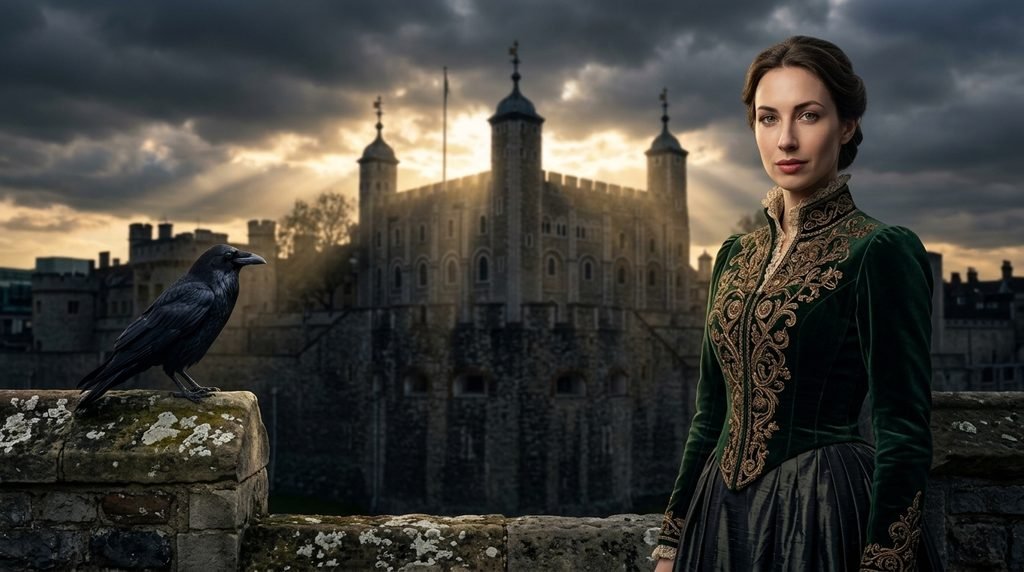
For nearly a millennium, a single stone fortress on the north bank of the River Thames has dominated the skyline, politics, and historical consciousness of England. The Tower of London is not merely an architectural landmark; it is a living vault of royal ambition, tragic execution, political betrayal, and unsolved mysteries. Over its thousand-year existence, this extraordinary complex served as a grand royal palace, a formidable stronghold, a terrifying prison, and the final destination for some of history’s most famous figures.
The Birth of a Fortress: William the Conqueror and the White Tower
The saga of the Tower began in 1066, immediately following the Norman Conquest. After defeating King Harold at the Battle of Hastings, William the Conqueror sought an unmistakable symbol to subjugate and intimidate the rebellious citizens of London. By 1078, construction was underway on the White Tower—a massive stone keep featuring walls fifteen feet thick.
Positioned strategically along the River Thames, the White Tower projected absolute Norman power. Over subsequent centuries, successive monarchs expanded the site with outer walls, defensive towers, and a deep moat, transforming it into an impenetrable fortress virtually immune to medieval siege warfare.
Lions and Polar Bears: The 600-Year Royal Zoo
Long before it became famous purely as a state prison, the Tower of London housed an incredible secret: England’s first royal menagerie. Beginning in the 1200s, European monarchs exchanged exotic animals as diplomatic gifts. For over six centuries, lions, leopards, camels, and even an elephant resided within the fortress walls.
Among the most famous residents was a white polar bear given by the King of Norway in 1252. The bear was kept on a long leather leash, allowing it to swim and catch wild fish directly in the River Thames. The royal zoo opened to the public in the 1700s, serving as a popular London attraction until the animals were officially relocated to create the London Zoo in the 1830s.
Traitors’ Gate and the Lost Princes
The Tower’s darker reputation took hold as it became the premier holding site for enemies of the Crown. Prisoners usually arrived by water, entering through the ominous archway known as Traitors’ Gate. To pass beneath this gate was to step into a shadow world where few high-profile captives ever walked out free. While common prisoners endured freezing stone dungeons, highborn captives lived in relative comfort, often carving poignant inscriptions, prayers, and names into the stone walls—markings that remain visible today.
Among all the chilling tales housed within these stones, none is more baffling than the disappearance of the Princes in the Tower. In 1483, following the death of King Edward IV, his twelve-year-old heir, Edward V, and his nine-year-old brother, Richard, were placed in the Tower under the protection of their uncle, Richard, Duke of Gloucester. Shortly after, the Duke declared the boys illegitimate and seized the throne as King Richard III.
The young princes were seen playing in the courtyard less and less until they vanished completely. Nearly two centuries later, in 1674, workmen renovating a staircase in the White Tower unearthed two small skeletons hidden beneath the stone steps, giving weight to the centuries-old theory of royal murder.
The Fatal Scaffolds of Tower Green
While many prisoners were executed publicly on nearby Tower Hill, executions of high status or royal blood were conducted privately inside the walls on Tower Green to avoid angry mobs.
The most famous figure to meet her end here was Queen Anne Boleyn, the second wife of King Henry VIII. After failing to produce a male heir, Anne was accused of treason and adultery under fabricated charges. On May 19, 1536, she was brought to Tower Green, where an expert swordsman summoned from France executed her with a single stroke.
Eighteen years later, another queen met an equally tragic fate on the same ground. Lady Jane Grey, known as the “Nine Days’ Queen,” was an innocent seventeen-year-old pawn in a deadly political struggle for the English crown. Deposed by Mary I, the gentle teenage queen was blindfolded on the scaffold on February 12, 1554, reaching out helplessly for the executioner’s block moments before her death.
Torture, Gunpowder, and Daring Escapes
Though English law generally restricted torture, special royal warrants made the Tower a site of severe interrogation. The most famous prisoner subjected to its harsh depths was Guy Fawkes. Caught beneath the Houses of Parliament in November 1605 with thirty-six barrels of gunpowder, Fawkes was brought directly to the Tower. Under intense physical torture, he finally broke, signing his confession with a trembling, barely legible signature.
Yet, the Tower was not entirely escape-proof. In 1716, the Scottish Earl of Nithsdale faced execution for his role in the Jacobite rebellion. On the night before his scheduled death, his courageous wife smuggled in women’s clothing, dressed her husband in the attire, and walked him straight past the guards to freedom and exile in Europe.
The Crown Jewels and the Immortal Ravens
Today, the Tower serves as the vault for the world’s most valuable regalia: the British Crown Jewels. Packed with thousands of rare gemstones and solid gold, these ceremonial items are still actively used by the royal family today. Their security was famously tested in 1671 when Colonel Thomas Blood managed to overpower the keeper, flatten the imperial crown with a mallet, and hide it beneath his cloak. He was captured at the gates, though King Charles II was so entertained by Blood’s audacity that he granted him a full royal pardon.
Overseeing the fortress grounds are its immortal guardians: the Tower ravens. According to an ancient legend, if the ravens ever leave the Tower, the fortress and the entire British Kingdom will fall. Today, a dedicated Ravenmaster cares for a minimum of six resident ravens, gently trimming their flight feathers to ensure they remain on the grounds.
guarded by Yeoman Warders (the iconic “Beefeaters”) and anchored by the 700-year-old nightly Ceremony of the Keys, the Tower of London remains a place where history continues to live.
Watch the Full Time-Travel Journey
Want to see these dark corridors, secret chambers, and historic execution sites brought to life visually? Head over to YouTube and watch our complete, immersive documentary episode on EVIE vs HISTORY.
Don’t forget to like, leave a comment with your favorite historical detail, and subscribe to the channel for weekly journeys through the world’s most fascinating historical mysteries!