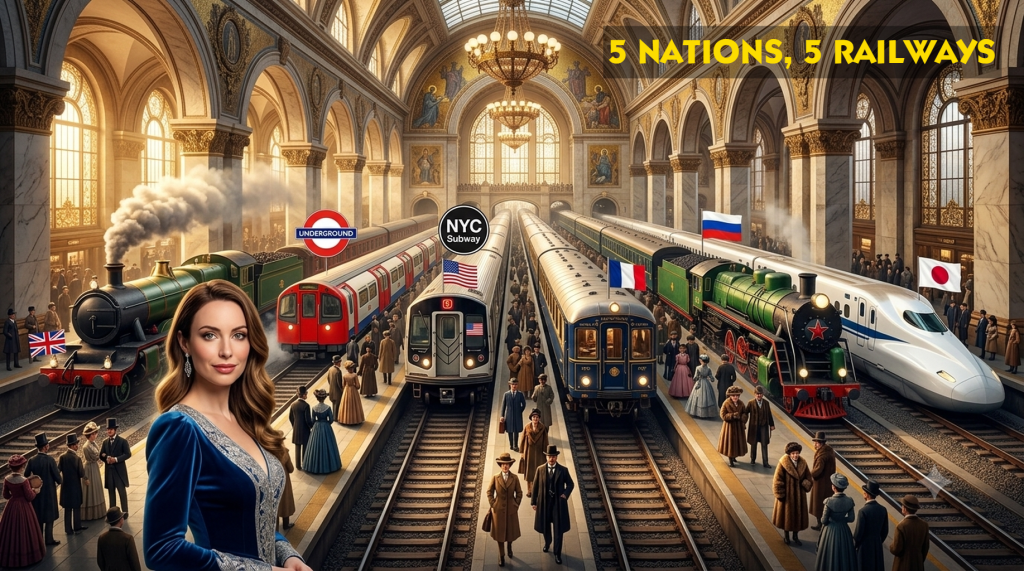
They were once called impossible. Yet the great railways connected our world and built the modern age. In a single century, humanity went from travelling no faster than a galloping horse to racing across the land at hundreds of miles an hour. This is the story of how five great nations — Britain, America, France, Russia and Japan — each gave the world an extraordinary railway, in a journey from the very first steam engine to the bullet train.
Britain: where the railway was born
The story of the railway begins in Britain. In 1825, the world’s first public steam railway opened, and in 1829 a locomotive called the Rocket proved that steam was the future. Within a few short decades, iron railways had spread across Britain like veins across the land.
But Britain’s boldest idea was to build a railway underneath London itself. In 1863, the London Underground became the first underground railway anywhere on earth. Imagine the wonder of it: steam trains thundering through gas-lit tunnels deep below the city streets. It was smoky, noisy and revolutionary, and Londoners flocked to ride it. The Underground changed how millions lived, worked and travelled, and it remains one of the most famous railways in the world today.
America: joining a continent
Across the ocean, a vast young nation had a dream: to join its east and west coasts across thousands of wild miles. Building the Transcontinental Railroad was a staggering undertaking. Thousands of workers laid track through deserts, mountains and brutal winters.
In 1869, the two railways finally met, and the line was famously joined with a golden spike. A journey that had once taken months could now be made in a single week. A continent had been united by rail. America then reached upward too, opening the New York City Subway in 1904, with grand stations whose soaring ceilings made them feel like palaces.
France: the railway as a work of art
If Britain built the railway and America gave it scale, France made it beautiful. In 1900, Paris opened its underground railway, the Métro, and its station entrances were stunning works of flowing Art Nouveau iron and glass. France had proved a railway could be elegant as well as useful.
And from Paris ran the most glamorous train the world had ever seen: the Orient Express. Its carriages were like a grand hotel gliding across the continent, carrying kings, diplomats, spies and the wealthy. It became a legend of mystery, romance and intrigue that still captures the imagination today.
Russia: scale and splendour
Our fourth nation made the railway vast. Russia is so enormous that crossing it required a railway of staggering length. The Trans-Siberian Railway is the longest railway line in the entire world, stretching nearly six thousand miles across seven time zones. Building it through Siberia’s frozen wilderness was an extraordinary feat of human determination. Even today, the full journey from one end to the other takes seven days.
Russia built something beautiful too, deep beneath its capital. The stations of the Moscow Metro were constructed like underground palaces, glittering with marble, chandeliers and golden mosaics. No one had ever seen railway stations of such breathtaking grandeur.
Japan: launching into the future
By the 1960s, Japan was rebuilding and reaching for tomorrow. Its engineers dreamed of a train faster than any the world had seen. In 1964, Japan opened the world’s first high-speed bullet train. Sleek, smooth and astonishingly safe, it raced along at speeds the steam pioneers could never have imagined. It transformed travel, and the whole world raced to copy it. From a steam engine in Britain to a bullet train in Japan, in just over a century, the railway had been reinvented.
How the railways connected humanity
These five great railways did far more than carry people. They carried ideas, trade, families and dreams across the world. They shrank our vast planet and brought distant nations closer together. Every time you board a train today, you ride on more than a century of human genius — the dreams of those early steam pioneers still carrying us forward.
Five nations, five legendary railways, one connected world. From iron and steam, they truly built the modern world.
Watch the full immersive documentary, “How 5 Nations Built the World’s Greatest Railways,” on our YouTube channel — and explore more world history on the blog.