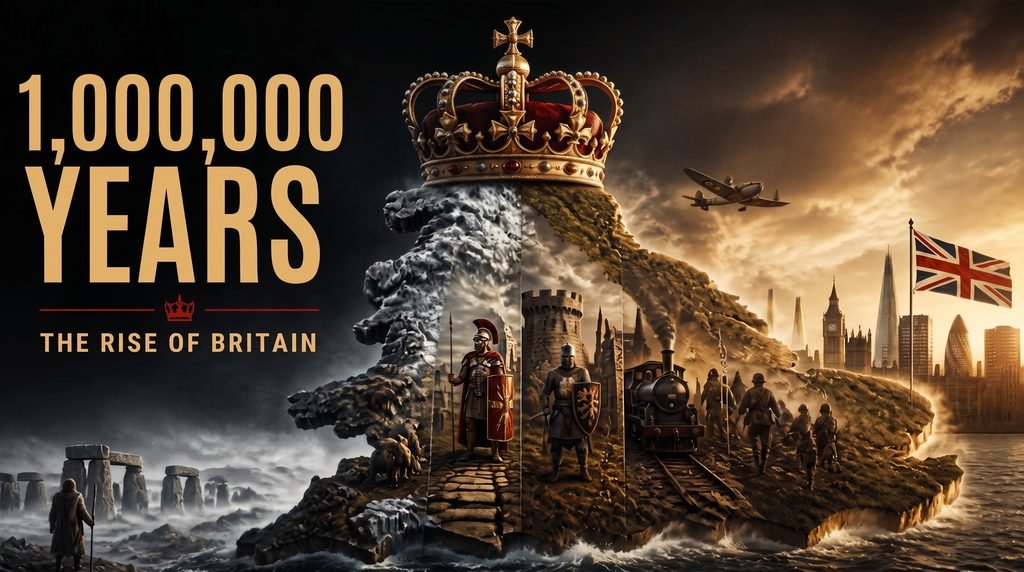
The Complete History of Britain: From the Stone Age to the Modern Era
Few landmasses have exerted as profound an influence on the modern world as the British Isles. Yet the story of Britain is not one of isolated destiny; it is an epic shaped by brutal invasions, shifting borders, cultural assimilation, and industrial revolutions.
From the hunter-gatherers of the Mesolithic to the architects of the post-war welfare state, understanding British history requires examining the pivotal eras that forged the nation.
1. Prehistoric Britain & Stonehenge (c. 8000 BCE – 43 CE) | history of England
Long before written records, early humans crossed the prehistoric land bridge known as Doggerland to settle the British Isles. By roughly 4000 BCE, Neolithic settlers introduced agriculture, permanently replacing nomadic hunting cultures with permanent settlements.
The most enduring symbol of this era is Stonehenge in the History of Great Britain on Salisbury Plain. Begun around 3000 BCE as a simple circular ditch and bank, its iconic sarsen stone circle was erected between 2600 and 2400 BCE. While later medieval folklore credited the monument to Merlin or giants, archaeology confirms it was built by sophisticated Neolithic and early Bronze Age communities aligned to celestial solstices. By 800 BCE, Celtic-speaking tribes arrived with iron metallurgy, constructing defensive hillforts across the rolling countryside.
2. Roman Britannia & Boudica’s Revolt (43 – 410 CE)
Julius Caesar led military expeditions to southeast Britain in 55 and 54 BCE, but full conquest did not begin until 43 CE under Emperor Claudius. The Roman legions encountered fierce tribal resistance across the island.
In 60–61 CE, Queen Boudica of the Iceni tribe led a devastating revolt against Roman brutality. Her rebel forces razed Roman settlements at Camulodunum (Colchester), Verulamium (St Albans), and Londinium (London), slaughtering tens of thousands before Roman governor Suetonius Paulinus crushed the rebellion at the Battle of Watling Street. To secure the northern frontier against Pictish raids, Emperor Hadrian ordered the construction of Hadrian’s Wall in 122 CE, marking the formal boundary of Roman civilization until Roman legions permanently withdrew around 410 CE.
3. Anglo-Saxons & The Viking Danelaw (410 – 1066 CE)
The collapse of Roman authority left a power vacuum filled by migrating Germanic tribes—Angles, Saxons, and Jutes. They divided England into rival kingdoms known as the Heptarchy, including Wessex, Mercia, and Northumbria.
This patchwork of kingdoms was shattered in 793 CE when Norse raiders sacked the monastery at Lindisfarne, initiating the Viking Age. In 865 CE, the Great Heathen Army arrived to conquer rather than raid. Only King Alfred the Great of Wessex survived the onslaught, securing a historic victory at the Battle of Edington in 878 CE. The resulting peace divided England, establishing the Danelaw—a territory governed by Scandinavian law. Decades of consolidation followed, culminating in 927 CE, when Alfred’s grandson, King Æthelstan, united the Anglo-Saxon kingdoms into the first unified Kingdom of England.
4. The Norman Conquest & Medieval Knights (1066 – 1485)
The fateful year of 1066 transformed England’s political landscape forever. Following the death of Edward the Confessor without a clear heir, William, Duke of Normandy, launched an invasion from northern France. On October 14, 1066, William defeated King Harold Godwinson at the Battle of Hastings.
William the Conqueror replaced the Anglo-Saxon elite with Anglo-Norman barons, securing control via stone motte-and-bailey fortresses and compiling the comprehensive tax audit known as the Domesday Book (1086). The High and Late Middle Ages brought profound structural shifts: King John was forced to sign the Magna Carta in 1215, curbing absolute monarchical power; the Black Death decimated one-third of the population in 1348; and the devastating dynastic conflict known as the Wars of the Roses concluded at the Battle of Bosworth in 1485.
5. Tudors, Civil War & The 1707 Union (1485 – 1714)
The Tudor dynasty ushered in religious and political upheaval. In 1534, Henry VIII passed the Act of Supremacy, severing ties with Rome to establish the Church of England. His daughter, Elizabeth I, presided over an era of maritime expansion, colonial ventures, and cultural flourishing.
Ideological conflict peaked under the Stuart monarchs. The English Civil War (1642–1651) pitted King Charles I against Parliament, led by Oliver Cromwell. Charles I was publicly executed for high treason in 1649, establishing a brief Interregnum before the monarchy was restored in 1660 under Charles II. In 1688, the bloodless Glorious Revolution firmly established a constitutional monarchy with the Bill of Rights (1689). The century closed with the landmark Acts of Union in 1707, which united the Parliaments of England and Scotland into the unified Kingdom of Great Britain.
6. The Industrial Revolution & The British Empire (c. 1760 – 1914)
Driven by rich coal deposits, mechanical innovations, and James Watt’s refined steam engine, late 18th-century Britain transformed from an agrarian economy into the world’s first industrial workshop. Canals, steam-powered textile mills, and George Stephenson’s railways altered the economic and demographic landscape.
Under the 63-year reign of Queen Victoria (1837–1901), Britain expanded its global reach through industrial output and naval supremacy. The British Empire became the largest imperial entity in human history, governing one-quarter of the world’s population across India, Africa, North America, and the Pacific—an expansion that spurred worldwide geopolitical dominance alongside severe colonial exploitation.
7. The Blitz & The 20th-Century Rebuild (1914 – Present)
The First and Second World Wars drained the nation’s resources and shattered the old world order. Between September 1940 and May 1941, Nazi Germany subjected British industrial centers and civilian hubs to relentless aerial bombardment known as The Blitz. Despite catastrophic destruction, the domestic population persevered under Winston Churchill’s wartime leadership.
The post-1945 landscape sparked profound domestic reform. The election of Clement Attlee’s Labour government led to the establishment of the National Health Service (NHS) in 1948 and the creation of the modern welfare state. Simultaneously, rapid decolonization saw the empire dismantle into the voluntary Commonwealth of Nations, ushering Britain into its contemporary role as a multicultural parliamentary democracy and diplomatic global power.
Uncover the Untold Layers of History
From the stones of prehistoric Salisbury to modern London, British history is a tapestry of resilience, conflict, and reinvention.
Subscribe to the EVIE vs HISTORY YouTube Channel (@evievshistory) for in-depth breakdowns, visual historical analyses, and unbiased deep dives into world history.
3. High-CTR Thumbnail Strategy
- Visual Concept: “The Evolution of the British Warrior / Sovereign” (Split Contrast). Instead of a generic map or landscape, use high emotional tension: A split-screen face morph comparing a Roman-era British warrior (blue woad war paint, snarling, rain and fire) directly confronting a 1940s Spitfire pilot or Churchillian figure wrapped in London Blitz smoke and searchlights.
- Composition: Rule-of-thirds split right down the middle with high volumetric contrast (orange fire/embers on left vs. cool slate-blue smoke on right). Keep the lower-right quadrant dark and clean to ensure the YouTube runtime timestamp never covers the subject’s face.
- Text Hook Overlay (Mobile Optimized): “10,000 YEARS” or “HOW IT BEGAN” (Bold condensed Gothic font, stark white with high-contrast black drop-shadow, top-left quadrant).